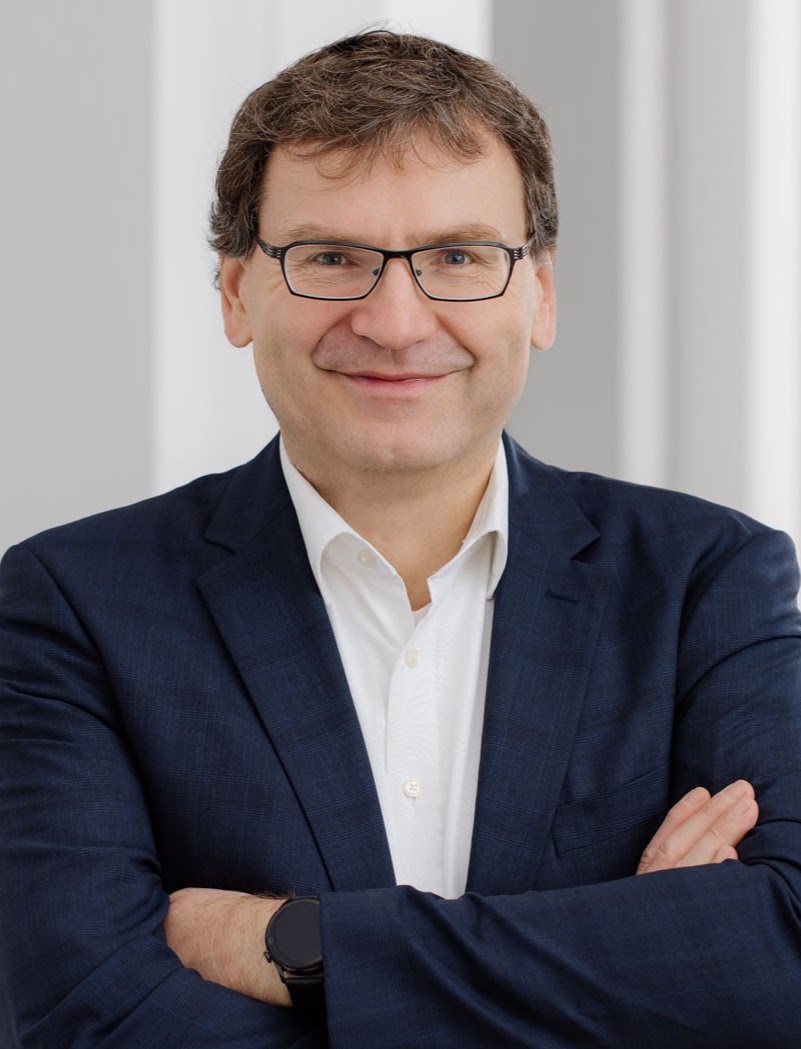
Portrait of Stefan Decker

Knowledge Graphs · Semantic Web · Data Spaces · AI

Stefan Decker

Professor at RWTH Aachen University (Informatik 5) and Director of Fraunhofer FIT

Dr. rer. pol. · Dipl.-Inform. · CEng FIEI · MRIA

Combining AI with Knowledge Graphs for Augmented Human Intelligence.

Portrait of Stefan Decker as the subject of a small RDF graph: professor at RWTH Aachen University, director of Fraunhofer FIT, working on the Semantic Web, Knowledge Graphs, Data Spaces and Generative AI :worksOn :worksOn :worksOn :worksOn :professorAt :directorOf Semantic Web Knowledge Graphs Data Spaces Generative AI RWTH Aachen University Fraunhofer FIT

My mission

Building a global “Networked Knowledge” ecosystem

I am working to realize a fundamental transformation in how humanity creates, shares, and uses knowledge. By converging Knowledge Graphs as the foundation of ground truth with Generative AI's creative capabilities, we are building a global "Networked Knowledge" ecosystem that augments human problem-solving across science, business, and society.

This vision builds on the pioneering ideas of Vannevar Bush's Memex and Doug Engelbart's vision for augmenting human intellect. Today, AI has given us unprecedented capabilities to realize this vision:

  • Knowledge Graphs and Linked Data

    Provide the semantic foundation of verified, interconnected facts - the ground truth that anchors AI systems.

  • Generative AI

    Brings creative problem-solving, natural language understanding, and the ability to synthesize new insights from vast knowledge bases.

  • Data Spaces

    Enable sovereign, automated exchange between organizations while preserving privacy and control.

  • The AI-Knowledge Synergy

    While GenAI excels at creativity and pattern recognition, Knowledge Graphs ensure factual accuracy and explainability.

At Fraunhofer FIT and RWTH Aachen, I lead initiatives that demonstrate this powerful combination - from AI-powered medical diagnostics grounded in verified clinical knowledge to industrial AI systems that combine creative optimization with engineering constraints. Through our work on explainable AI, we show how creative AI and structured knowledge together solve real-world challenges.

This convergence represents the next phase of human-machine symbiosis: AI's creative power guided by humanity's accumulated, verified knowledge - enabling us to tackle our most complex challenges with both imagination and accuracy.

Now

Current work

Roles

Projects

Recent publications

  1. Conversational Data Management: A Multi-agent Natural Language Interface for Semantic Data Lakes S. Hoseini, N. Mittelstädt, V. Herrmann, S. Decker, C. Quix · ADBIS 2026
  2. What Does ODRL Mean? A Cross-Level Ontological Grounding of Permissions, Prohibitions, and Duties in UFO-L D. Mustafa, C. Lange, G. Guizzardi, D. Collarana, C. Quix, S. Decker · FOIS 2026
  3. SemTS: Ontology and Vocabularies for the Semantic Categorization of Time Series Knowledge A. Graß, R. Deshmukh, C. Lange, D. Collarana, C. Beecks, S. Decker · ESWC 2026
  4. FAIR Data Assessment Using LLMs: The Fair-Way A. Sharma, S. Sowe, S. Kim, S. Hoseini, F. Limani, Z. Boukhers, C. Lange, S. Decker · CIKM 2025
  5. GRAFT – Graph Retrieval Augmented Generation Fine-Tuning Approach M. Busch, G. Defilippis, P. Weiß, C. Beecks, S. Decker, D. Collarana · IEEE BigData 2025
  6. The Culture Dataspace (Datenraum Kultur) – a Data-Sovereign Open-Source Digital Infrastructure based on the Eclipse Dataspace Components (EDC) Framework G. Toubekis, S. Decker · ISPRS Archives 2025

All publications on Google Scholar

About

About me

I am a professor at the RWTH Aachen University, and a Director of the Fraunhofer FIT Research Institute, part of the Fraunhofer Society.

My main research field is the Semantic Web. The usual academic self promotion: my Google Scholar profile claims my publications have received more than 30000 citations and I have an h-index of 84 (the h-index is a metric aiming to measure scientific productivity). Google Scholar also searches authors per organisations (e.g., all authors in Google Scholar from RWTH Aachen) or even (exploiting the country code) from a country. I also maintain a Linked-In profile.

Career

  1. Today RWTH Aachen University Professor
  2. Today Fraunhofer FIT, part of the Fraunhofer Society Director
  3. 12 years National University of Ireland, Galway Director of the Digital Enterprise Research Institute and later Insight
  4. 2 years ISI, University of Southern California Research Assistant Professor and Computer Scientist
  5. 3 years Stanford University, Computer Science Department (Database Group) PostDoc and Research Associate
  6. 4 years Institute AIFB, University of Karlsruhe (now KIT Karlsruhe) PhD Student and Junior Researcher

Track record

Selected past accomplishments

Past accomplishments include:

  1. Data spaces at Fraunhofer FIT and i5

    Fraunhofer FIT and my chair i5 at RWTH Aachen is now contributing to a large number of different dataspace initiatives and projects: NFDI4Health, NFDI4DataScience, SMITH, common European Energy Dataspace, common European Green Deal Dataspace, german mobility dataspace, to name a few.

  2. W3C DCAT

    The W3C DCAT recommendation was created by a PhD student of mine: Fadi Maali and suggested to the commission by Vasillios Peristeras. It is now the standard metadata format for all Open Data portals in the European Union and gains traction for research data management and many other application areas.

  3. Ireland's Open Data Strategy

    My team and myself (mostly my team) drafted the governmental Irish Open Data Strategy and provided the alpha version of the Ireland's Open Data Portal.

  4. Growing DERI

    After I took over the directorship of DERI in 2006 DERI doubled in size and far more-than-doubled its scientific output and reputation. According to Microsoft Academic Search until DERI transitioned into the Insight Centre for Data Analytics, DERI was recognised as one of the top organisations in World-Wide-Web research. For these successes DERI was selected by SFI for inclusion into the Insight Centre for Data Analytics, enabling research funding for another 6 years.

  5. The Social Semantic Desktop and NEPOMUK

    I coined and established the term Social Semantic Desktop for Personal Knowledge Management with Semantic Web Methods and initiated a large scale EU project (Budget: 17.5 M Euro) dubbed NEPOMUK which included multinationals like IBM, HP and SAP, small companies like Cognium, research institutes like FZI, DFKI, L3S and DERI, application partners like Institute Louis Pasteur, and a dissemination partner like Edge-IT (Mandriva Linux). The goal of the project was to provide a crystallization point for the development of the Semantic Desktop infrastructure. The results are now part of KDE and distributed with Linux.

  6. The Semantic Web Working Symposium

    I initiated and co-organized (with Isabel Cruz, Jerome Euzenat, and Deborah McGuinness) the Semantic Web Working Symposium at Stanford University, the first large scale Semantic Web event (> 250 participants), which spanned the International Semantic Web Conference, which is now organized by the Semantic Web Science Association.

  7. From SHIQ to OWL

    Together with Ian Horrocks I created an RDF representation for the Description Logic SHIQ. The result was merged with the at the time XML-based OIL. Then the RDF part of OIL was the main input for DAML+OIL (I was member of the DAML+OIL Joint Committee), which in turn was the main input for OWL - the Web Ontology Language.

  8. RDF for Protégé

    Since I perceived an editing environment as being critical for the success of Semantic Web standards I pushed for Protege becoming Open Source and wrote the first RDF import/export for Protege, which made Protege compatible with Semantic Web standards (see my announcement to the RDF interest mailing list). Protege is still the most popular editor for Semantic Web Ontologies.

  9. HyperCuP

    Together with Mario Schlosser, Michael Sintek and Wolfgang Nejdl we created HyperCuP, the first Ontology-based routing algorithm and hypercube topology for P2P networks (the main genius behind HyperCuP was Mario). HyperCuP has been used by a couple of projects as a P2P topology.

  10. Edutella

    Together with Wolfgang Nejdl I cofounded the Edutella project, the first metadata exchange infrastructure for RDF.

  11. The Semantic Web information foodchain

    The Semantic Web information foodchain presented in an ECDL 2000 paper and depicted at SemanticWeb.org is widely used as an architectural model and motivation for Semantic Web technology.

  12. A DARPA grant at Stanford

    While being at Stanford University as a PostDoc (without having finished my PhD at the time) in 1999 I acquired a 1 M US$ grant from DARPA (DAML, Ontoagents, PI: Prof. Gio Wiederhold). I was named key person for the grant, which means the grant would have stayed with me if I had moved. The grant enabled me to establish one of the first Semantic Web research groups.

  13. The first RDF query and inference system

    Together with Dan Brickley, Janne Saarela, and Jürgen Angele I created the first Query and Inference system for RDF (see the QL'98 paper).

  14. Ontobroker and an early Semantic Web PhD

    My work on Ontobroker (joint work with Dieter Fensel and Michael Erdmann) was cited as an inspiration for the DARPA DAML program, which heavily influenced the Semantic Web effort and led to the development of OWL. My PhD thesis on the Semantic Web was one of the first in the field, exploring the use of Semantic Web technologies for Knowledge Management.

  15. An undergraduate thesis on integrity checking

    My undergraduate thesis generalised all at the time known methods for Incremental Checking of Integrity Constraints in Deductive Databases and is the most formal work I have done. It also is the most incomprehensible work I have done. Coincidentally it also is the work with the least impact. The core is a 4 page double induction proof over a data structure representing proofs of Logic Programs done with the SLDNF-resolution procedure. I still believe the described Integrity Checking Method has tremendous application potential (it allows for declarative testing of a data set wrt. to compliance with expressive integrity constraints) and just needs to be modernised, properly explained and properly published (in English, for starters). Maybe I find the time when I am retired.
Vision

The vision and its roots

DERI NUI Galway – Semantic Web Research Making the Internet Smarter YouTube · loads when you press play
Research Ireland

Science Foundation Ireland produced a great introduction to DERI and our goals and ambitions. DERI and the SFI Research Program is now in the past and has transitioned into the Insight Centre for Data Analytics, and I have transitioned to Fraunhofer FIT and RWTH Aachen, but my research vision remains valid - augmented with infrastructures like data spaces and technologies like generative AI.

Historic resources

And here is confirmation that part of it transitions already into reality: 10 years after we introduced the concepts in the "Social Semantic Desktop Paper" and the subsequent Nepomuk project Microsoft implements a Semantic Desktop - see the brain? Now if only Office Graph would work also with non-Microsoft products - and maybe even across systems...? Maybe build the capabilities into the operating system?

All of this continues the work of Douglas Engelbart...

Ted Nelson's Eulogy for Douglas Engelbart YouTube · loads when you press play
Computer History Museum

Anecdotes

Anecdotes and other stuff...

2010

Racing the ash cloud

I made national news in Ireland for buying a car during the Icelandic ash cloud incident in 2010, when most of Europe's Air Space was closed for commercial flights. Four of us were stranded in Madrid after attending a Future Internet conference in Valencia. I bought a car to drive back to Ireland to be in time for a meeting at Science Foundation Ireland. Amazingly, buying a car turned out to be the cheapest and fastest solution - I was able to sell the car back in Ireland. During our drive back I posted a short report of our activities to get home on the RTE website, where it was picked up and reported on in Morning Ireland, a popular radio show in Ireland. It was also reported on the BBC Website. Another team from Ireland decided to try the public transportation route, and we were racing who was back faster. I am proud to report despite one other team's head start of one day (the time it took to buy a car) we made it back on Irish soil one day earlier.

Stanford

The original Google server

The original Google Server consisting of 10 4GB disks and a case built out of Lego was for a while in my office in Stanford University.

Stanford

Meeting Doug Engelbart

When organising the SWWS in Stanford Doug Engelbart contacted me to speak at the event. I had subsequently several meetings with Doug (including a birthday party that he had for Ted Nelson in his house in Atherton). These meetings heavily influenced my Semantic Desktop and Semantic Web work.